

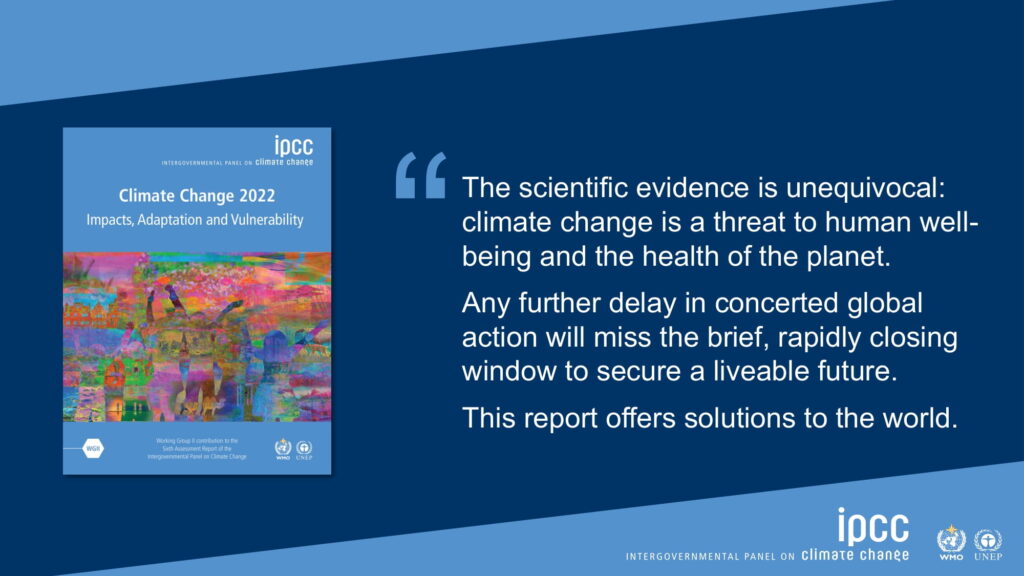
One Planet Abingdon volunteer Patrick sums up the latest International Panel on Climate Change report. The full version of the report, titled “Climate Change 2022: Impacts, Adaptation and Vulnerability” is available here.
The International Panel on Climate Change (IPCC)
Since 1990 the IPCC has supported 3 Working Groups (WG): WG I evaluates the physical basis for climate change; WG II the impacts of, and adaptation to, climate change; and WG III the mitigation of climate change. Every few years an Assessment Report (AR) is published which combines the outputs of the three WGs. The Fifth AR was published in 2013/14, and the Sixth AR in 2021/22. Each includes lengthy documents representing the views of up to 195 countries, the most recent being the Sixth AR for WG II published on 28 February 2022 which is more than 3500 pages long.
Main Conclusions from 6th AR for WGII
Since the start of the Industrial Revolution the atmospheric concentration of the main greenhouse gas, CO2, has risen from about 280 parts per million (ppm) in the late 1700s, to 52ppm in 1990 when the work of the IPCC started and 418ppm today. Over the last 30 years there has been no sign of slowing down in the rate of CO2 increase despite all the warnings of scientists; as a result the rise in global temperature, which was about 0.9oC in 1990 (compared to the late 1800s), is now about 1.2oC and likely to exceed during the 2030s the 1.5oC target set at the 2015 COP meeting in Paris in order to avoid catastrophic effects of warming and associated changes in rainfall patterns and of extreme climatic events. The likely impacts of the magnitude and rapidity of change on ecosystems and on human society are the focus of the work of WG II. The conclusions include:
- Climate change is now significantly affecting the earth’s environment and human health and security everywhere, and we have reached the stage when every 0.1oC increase in temperature matters. The poorest people, both globally and nationally, will be most affected as they are least able to adapt to change. Failure to address the issues of inequality and social justice will only make the impacts more severe.
- The window of opportunity for reducing CO2 emissions and introducing carbon pricing is closing fast even though it is well understood that appropriate investment and economic reform will lead to sustainable long term environmental and social benefits. Adaptation measures to higher temperatures and to climatic extremes have their limitations; many depend on new or developing technologies not available to everyone and carry the risk of failing to address the common good.
- An improved understanding of the capacity of earth’s natural capital (living organisms, ecosystems etc.) for sequestering and storing carbon is needed for reliable determinations of carbon budgets, giving special attention to forests, soils, wetlands and aquatic sediments. New technologies and strategies in agriculture will play a vital role in enhancing carbon sequestration and in minimising the loss of soil carbon and the reduction of biodiversity. However, it is inevitable that more plant and animal species will become extinct.
- Safeguarding the future of cities represents a special challenge in terms of infrastructure resilience to heatwaves and flood damage and of the effects of general pollution on human health. Sea level rises of up to 1m are expected by the end of this century and, in combination with increased storm frequency and intensity, will threaten the future of many coastal cities.
- Regional variations in the vulnerability of people and of ecosystems to climate change reflect patterns in population density, the protection of natural capital, inequity within and between communities and so on. In this context, vested interests, both political and commercial, represent major barriers to the mitigation of, and adaptation to, climate change. It is noteworthy that militaries are one of world’s biggest emitters of greenhouse gases.
Significance of the WG II Report for the UK
The UK is not well prepared for, or adapted to, the expected impact of climate change on future societies as described by WG II; there is considerable resistance from major corporations, from economists and from political pressure groups, such as the Net Zero Watch and the parliamentary Net Zero Scrutiny Group, to address this issue as an integral part of the levelling up and make the necessary long-term investments. Shortcomings include:
- The unilateral approach of the UK to defining net zero carbon emissions as adopted by the government in its Net Zero Strategy is dishonest; it does not account for the very large carbon costs of our imports or of international travel by UK citizens. Furthermore, the relative contribution of the UK to current carbon emissions (~1% of the world’s total) is a just a third of its contribution to total historical emissions affecting the climate system; global warming today reflects cumulative carbon emissions over the last 150 years.
- Decisions by central government to cut overseas aid, to maintain fossil fuel subsidies, to fund expensive transport infrastructure projects and to restrict investment into new sources of renewable energy (eg tides) are not consistent with any policy for achieving net zero emissions, nationally or globally. Successful mitigation and essential adaptation will also require decentralised investment so that inequalities within our society are addressed and the environmental concerns, priorities and need for engagement by local communities are met.
- Immediate action is required to reduce our dependency on private vehicles by improving public transport especially in rural areas, to reduce heat loss from older houses through better insulation, and to ensure that new housing is dependent solely on renewable energy.
- The UK Net Zero Strategy gives scant attention to farming (0.6% of GDP) as a source of greenhouse gases (>10% of total), and to its current negative effects on biodiversity, carbon storage by soils and water quality. We must consume less meat, allow insect populations to recover and recognise how changes in climate will affect the types of crop we grow as well as their flowering and growing times.
- New policies are needed for managing the impacts of events overseas, ranging from climate-related crop failures and mass movements of people to new pandemics, global-scale pollution (eg plastics), exhaustion of raw materials, wars etc.
- Technical innovations and digitalisation over the next 30 years are also likely to affect energy sources and provision, transport, farming, recycling of materials, human health etc in ways that are difficult for us to imagine now. These changes will require substantial financial investment and sacrifice but provide the platform for long term social and economic stability. It seems inevitable that we will have to spend a greater proportion of disposable income on food and health as the world continues to warm and as global population continues to rise.